 TAC Game Club


Game rules
TAC game rules
Everything you need to know to play TAC – clearly and simply explained
Preparation
Game components & setup
Game components
1 game board, 16 marbles (4 per player), 104 game cards (including 4 Master cards), rulebook and reference cards
Number of players
TAC is a team game for four players: the two players sitting opposite each other form a team. A game lasts 45 to 60 minutes, for ages 8 and up.
Game Setup
Place the game board in the center. Each player places their four marbles in the Base to their right. For the basic game, return the four master cards to the box. Shuffle the cards, then deal five cards to each player.
The game board
Each player has three areas of their own: the Base (the corner bay where the four marbles start and return after being captured), the Start position (the field where a marble enters the track), and the Home with four fields, where the marbles move at the end. Between them is the track, the ring of fields, with the card area in the center.

The game board
What's where on the board?
Four areas, one path: the marble starts in the base, enters the track at the start field, and moves into its own home area after one lap.
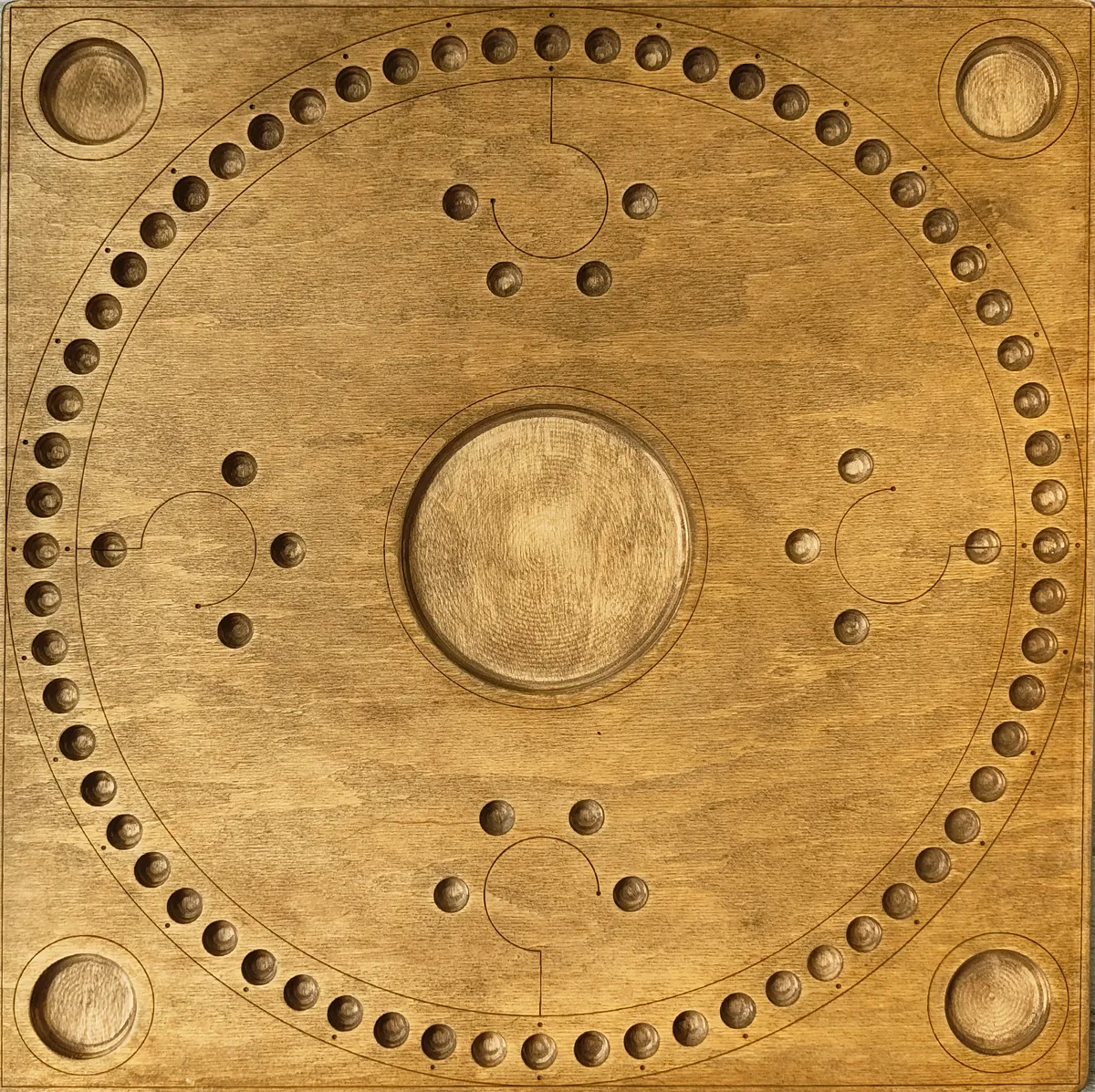
- 1
Base
The corner recess to your right. Your four marbles start here—and this is where they return if they are captured.
- 2
Start field
The field where a marble enters the track from the base. From here, it later turns off into its own home area.
- 3
Track
The ring of fields around the board. All marbles move clockwise here for one full lap.
- 4
Home area
Your four goal fields. No marble may be jumped over in the home area – you must move to a free field.
- 5
Card tray
The recess in the center of the board for the draw pile and discard pile.
Only one player's area is marked. For the other three, the layout is the same but rotated: their own base, start field, and home area.
Game goal
How to win at TAC
The goal is clear – the path is full of tactics and surprises.
Marbles to Home
Each player moves their four marbles once clockwise around the track and then into their own Home.
Team goal
The team that first gets all eight marbles of both players into home wins.
Order
No marble may be jumped over in Home – you must move to a free field. If no free field remains in front of a marble, it is "locked in" and can no longer be moved. This requires planning and foresight.
Help allowed
If a player has all their own marbles in Home, they move their team partner's marbles from then on.
No jumping
Marbles cannot jump over any other marble—neither your own nor those of your opponents. This makes the sequence of moves a strategic challenge.
The winning move can be stopped
Even victory isn't certain: The TAC card can undo the move that brought a team's eighth marble home – the marble must then go around the track again.
If you can, you must
If you can make a move, you must make it: discarding cards without using them is only permitted if no card in your hand allows for a move. This applies even if the move harms your own team. If a card's value exceeds the distance the marble can travel, it is not a possible move. Which of the possible moves you choose is up to you—there is no obligation to open or to capture.
Gameplay
A round of TAC – step by step
Each round follows the same sequence:
Deal cards
Five cards are dealt to each player. Once these have been played after five rounds, the next player deals – the deck is only shuffled when it's empty. The basic version consists of 100 cards; in the master version (104 cards including Angel, Devil, Warrior, and Jester), six cards are dealt in the final deal – the master round.
Declaration
After the deal, everyone audibly announces whether they hold an opening card (1 or 13): "I can" or "I cannot" – supported by a thumb up or down. The announcement is made after every deal; the number of opening cards remains secret.
Exchange
Each player gives their team partner a card face down. You may only look at the received card after handing over your own—and the exchange is always mandatory.
Choose & play card
Players take turns playing a card face up and executing the move. You may only discard a card without using it if no card in your hand allows a move – if you can move, you must move.
Move marble
The played card determines how many fields a marble moves. Some cards have special effects (e.g., Trickster, Warrior, TAC card).
Marble capture
If a marble lands exactly on another marble, that marble is captured and returned to its Base—regardless of color, including your own marbles or those of your team partner.
Special cards
Special cards in the deck
1 / 13 (Opening or Moving)
With a 1 or 13, you may place a marble from the Base onto your Start position – this is the opening. Both cards can also be used instead to move one or thirteen fields.
The 4 (backwards)
The only card that moves counter-clockwise: move one of your own marbles four fields backward. This move is compulsory—no marbles may be jumped over, even when moving backward, and any marble exactly four fields back is captured. Used skillfully, the 4 saves almost an entire lap: move backward first, then use a matching card to go directly into Home.
The 7 (splittable)
The 7 can be split into any number of single steps and distributed across several of your own marbles – including seven single-field moves. All seven steps must be used. It is the only card that captures marbles it passes over, including your own if necessary, and it can capture several marbles in one move. Only with the 7 can marbles in Home be rearranged.
The 8 (miss a turn)
Move eight fields – or skip the next player; they then discard a card unused and face up. You can only skip a player if you have a marble on the track. If played as the last card of a deal, only the move of eight fields is possible.
Trickster
Any two marbles on the track swap places – your own, opponents', or your partner's, in any combination. Requirement: you must have a marble on the track. Marbles in Home are off limits.
TAC card
The strongest card: It undoes the move of the player to your right – their marble moves back – and you use their card for your own move. Requirement: You must be able to use the undone card yourself.
Angel
For the next player clockwise, place one of their marbles from their Base onto their Start position. If this player has no marbles left in their Base, instead move one of their marbles on the track forward one (1) or thirteen (13) fields.
The Devil
You look at the hand of the next player (clockwise), pick one of their cards, and carry out the move for them. That player's turn is then used up.
Warrior
The marble following one of your own marbles clockwise is captured—regardless of its color—and your marble advances onto the vacated field. Without any of your own marbles on the track, the Warrior is forfeited.
Jester
When the Jester is played, hand cards are swapped counter-clockwise. Then, the player who played the Jester plays another card.

Game rules
Rules you need to know
Small rules, big impact – they often decide a game more than special cards.
Multiple marbles on the track
You may have several of your own marbles on the track at the same time – there is no upper limit.
First out, then home
A marble placed directly from the Base onto the Start position may not move straight into the Home. It must have left the Start position at least once.
Move further in Home
A marble in Home may move further to its final position with the matching card – even if you have no more marbles on the track.
Once in Home, never out
A marble in Home does not return to the track. The only exception is the TAC card played by the next player, which undoes the move into Home.
Complete your moves
Every move must be carried out in full – a started 7 cannot be interrupted halfway.
No consultation
Arrangements regarding the game are not permitted—neither spoken nor through signs. Only in a teaching game does it make sense to openly discuss your shared TACtics.
Master cards must be played
In the Master version, all Master cards except the Warrior must be played – even if you have no marble of your own in play and would otherwise be unable to make a move.
In detail
The TAC card in detail
The TAC card has a specific rule for almost every situation. Expand to read – you don't need them for your first game.
Requirement and obligation
The TAC card can only be played if you can use the withdrawn card yourself – otherwise, it remains in place or must be discarded unused. The same applies in reverse: if you can, you must. It cannot be withheld, even if it harms your own team. If you withdraw a card with two functions (1, 8, 13), you choose freely which one to use.
After a capture
The move is undone and the captured marble returns to its previous position on the track. Then you use the retrieved card for your own move.
After a move into Home
This is the only exception to 'once in Home, never out': the move into Home is undone, and the marble returns to the track.
After the deal
The TAC card cannot be used as the first card after the deal – nothing can be undone across the deal.
After the 8
If eight fields are moved, the move is undone and you decide whether to move eight fields or skip the next player. Anyone who must skip because of an 8 and holds a TAC card may play it – but doesn't have to; they can also discard it without using it.
After the Trickster
The swap is undone, then you swap two marbles yourself. If a marble was placed back on its Start position, it cannot go directly into the Home area from there – it must go around the track as normal.
After an unused discarded card
Then there's nothing to undo – you simply take over the function of this card. If a TAC card itself is discarded unused, the next TAC card refers back to the previous card.
TAC on TAC
The second TAC card undoes the first one: The previous move is restored, and the second TAC player now uses the card that was before the first TAC card. Three or four consecutive TAC cards are possible.
Against the winning move
The TAC card may and must undo the move with which a team brings its eighth marble home – provided you can use the card played for that move yourself. After that, no further TAC card is possible.
After the master cards
After the Jester, it is not the card exchange that is undone but the card the Jester player last played. After the Warrior, the captured marble returns, and you may capture the marble in front of one of your own. After the Angel, its action is reversed and you execute it yourself for the following player. After the Devil, this practically never happens – he would have had to choose your TAC card specifically.
Ready for the next level?
Read our tournament rules and find out how official TAC tournaments are organized and played